
SEP IRA vs. Solo 401(k): Which Fits Your Self-Employed Business?
SEP IRA vs. solo 401(k): which may fit? It depends on your income, whether you have employees, and how much administration you want. A SEP IRA takes employer contributions only and is simpler to set up. A solo 401(k) allows both employee and employer contributions, but it is generally for owners without employees and involves more paperwork.
SEP IRA vs. solo 401(k): which may fit? It depends on your income, whether you have employees and how much administration you want. A SEP IRA takes employer contributions only, calculated as a percentage of compensation, and is simpler to set up. A solo 401(k) adds employee deferrals but is generally for owners without employees and takes more paperwork.
Being self-employed means you are the one who has to plan for your own retirement, and it often becomes an afterthought. Two common options for self-employed people are the SEP IRA and the solo 401(k). Both can offer pre-tax savings, and both may allow Roth contributions depending on how the plan is set up. This guide compares them for solopreneurs, founders and small business owners.

SEP IRA vs. Solo 401(k): Side-by-Side Comparison
Dollar figures are IRS limits for the year shown and are adjusted annually. What you can actually contribute depends on your income, your business structure and your plan document, so treat this as a starting point.
| SEP IRA | Solo 401(k) | |
|---|---|---|
| Who contributes | Employer only (you, as the business owner). Employees cannot contribute. | You in two roles: as the employee (salary deferral) and as the employer. |
| How the contribution is calculated | Up to 25% of compensation. For a self-employed owner, the IRS requires a special calculation that lowers the effective rate. | Employee deferral up to 100% of earned income, up to the annual deferral limit, plus an employer contribution up to 25% of compensation (also a special calculation if self-employed). |
| Employee deferral limit | Not applicable | $24,500 in 2026; $25,500 in 2027 (IRS) |
| Overall limit from all sources | $72,000 in 2026; $75,000 in 2027 (IRS) | $72,000 in 2026; $75,000 in 2027, not counting catch-up contributions (IRS) |
| Compensation counted | Up to $360,000 in 2026; $375,000 in 2027 (IRS) | Up to $360,000 in 2026; $375,000 in 2027 (IRS) |
| Catch-up contributions, age 50+ | Not available on SEP contributions | $8,000 in 2026 and $8,500 in 2027, or $11,250 and $11,750 at ages 60 to 63, if the plan permits (IRS) |
| Roth option | The employer may choose to accept Roth SEP contributions | May be available if the plan document allows |
| Employees | Eligible employees generally must receive the same percentage of pay | Generally for owners with no employees other than a spouse; eligible employees must be included and testing may apply |
| Setup | Form 5305-SEP or a provider's prototype document | A plan document through a provider, with ongoing administration |
| Annual IRS filing | Generally none for the employer | Form 5500-EZ if the plan has $250,000 or more in assets at year-end |
| Who it may suit | Owners who want simplicity and flexible year-to-year contributions | Owners with no employees who want more contribution flexibility and can handle more administration |
Sources: IRS, 401(k) limit increases to $25,500 for 2027 (IR-2026-136, November 12, 2026) and Notice 2026-66 (2027 limits); IRS, COLA increases for dollar limitations on benefits and contributions and 401(k) and profit-sharing plan contribution limits (2026 limits); IRS, One-participant 401(k) plans and Simplified Employee Pension plan (SEP).
How Are SEP IRA and Solo 401(k) Contributions Calculated?
A SEP IRA is funded by the employer only. The IRS caps a contribution at the lesser of 25% of compensation or the overall dollar limit for the year. When you are self-employed, "compensation" is your net earnings from self-employment, reduced by half of your self-employment tax and by your own contribution. Because your contribution and your plan compensation depend on each other, the IRS provides a calculation guide and a rate table and worksheets in Publication 560.
A solo 401(k) lets you contribute in two roles. As the employee, you can defer up to 100% of earned income, up to the annual deferral limit. As the employer, you can add a nonelective contribution up to 25% of compensation, using the same special calculation if you are self-employed. Total contributions, not counting catch-up contributions, cannot exceed the overall limit for the year.
Which plan allows a larger contribution depends on your income and business structure. At lower earnings, the employee deferral in a solo 401(k) may let you save a larger share of income than a percentage-of-compensation SEP. At higher earnings, both plans can reach the same overall limit. A tax professional can run the numbers for your situation.
Can You Contribute to a SEP IRA and a Solo 401(k)?
Possibly, but the contributions generally count toward one combined limit. The IRS says you can maintain a SEP and another plan, and the overall limit ($72,000 for 2026 and $75,000 for 2027, before catch-up contributions) applies to contributions to all of an employer's defined contribution plans, SEPs included. Your own employee deferral limit ($24,500 for 2026 and $25,500 for 2027) applies to you as a person across all plans, not plan by plan.
A few points to keep in mind:
- Paperwork changes. The IRS model Form 5305-SEP cannot be used if you maintain another retirement plan (other than another SEP), so you would need a prototype or individually designed SEP document.
- A day job is different. The IRS says you can set up a SEP for your self-employment income even if you participate in your employer's retirement plan at a second job. Your employee deferrals to the day-job 401(k) and to a solo 401(k) are added together against the same personal limit.
- Deductions are interdependent. The amount you can deduct for your own contributions depends on the plan type, your net earnings and the other plans you maintain.
Sources: IRS, Retirement plans FAQs regarding SEPs and One-participant 401(k) plans; overall and deferral limits as cited above. Because rules differ by situation, confirm with a tax professional before contributing to more than one plan.
Who Tends to Consider Each Plan?
This is a general look at how the plans come up for different owners, not a recommendation.
Solopreneurs and freelancers with no employees
Both plans are generally available. The trade-off is often simplicity (SEP IRA) versus contribution flexibility and added administration (solo 401(k)). If your plan assets reach $250,000 or more at year-end, a solo 401(k) generally requires an annual Form 5500-EZ.
Founders and owners of an S-Corp or partnership
If your business is taxed as an S-Corp, the pay you take as W-2 wages may drive what you can contribute, rather than business profit. Our post on whether to elect S-Corp status covers that structure. If you are a partner, the IRS notes that only the partnership, as the employer, can maintain and contribute to a SEP, and each partner is treated as an employee of the partnership for this purpose.
Small business owners with employees
A solo 401(k) is generally built for owners with no employees other than a spouse. Once you have eligible employees, they generally must be included, and testing may apply. A SEP IRA can cover employees, but the same percentage of pay generally must go to every eligible employee, which can raise the cost as your team grows. Other plan designs exist for businesses with staff, and the right fit depends on your payroll and goals.
Is There a Year-End Deadline for a Solo 401(k)?
Timing is one reason to look at this now, with 2026 ending on December 31. According to IRS Publication 560, the plan generally must be set up by the last day of the tax year for you to take a deduction for that year, and an owner's employee deferrals must be elected by the end of the tax year. The deferrals themselves can then be made by the tax return filing deadline, including extensions.
There is a special rule. For 2023 and later years, a sole proprietor with no employees can adopt a 401(k) plan after the end of the tax year, as long as the plan is adopted by the tax filing deadline without extensions. A SEP IRA is more flexible on timing: the IRS says you can set up a SEP for a year as late as the due date, including extensions, of your business tax return for that year.
Opening a plan with a provider can take time, so if you are weighing a solo 401(k) for 2026, it may help to start the conversation soon. Source: IRS, Publication 560 (2025 returns) and Simplified Employee Pension plan (SEP).
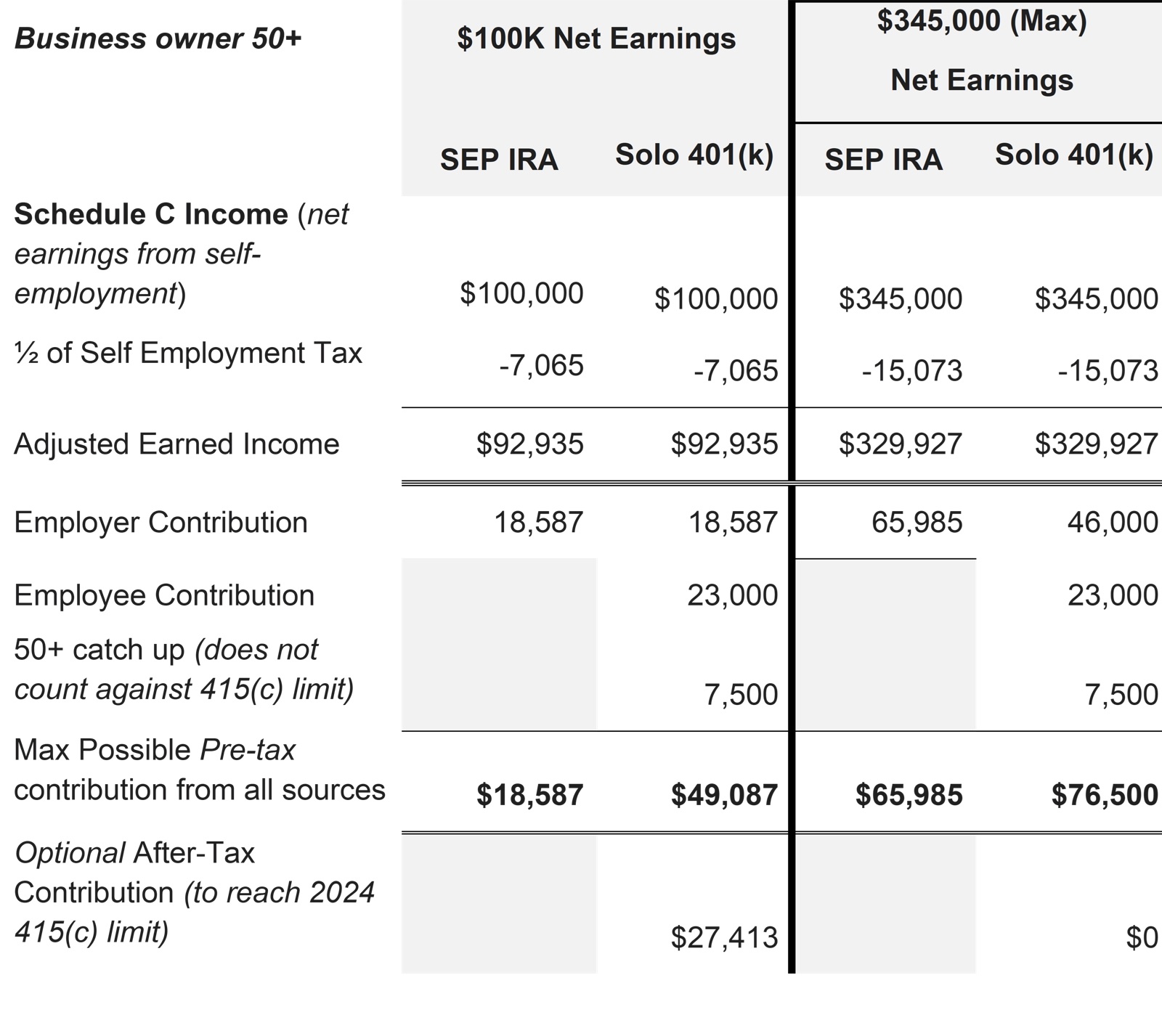
Hypothetical Illustration at $100,000 of Income
The graphic below is a hypothetical illustration of how contributions can differ for a business earning $100,000 in 2024. It uses 2024 limits, is for illustration only, and is not a projection or a recommendation. Results vary by individual circumstances, and the limits listed in the comparison table above are the ones that apply for 2026 and 2027.
Frequently Asked Questions
What is the difference between a SEP IRA and a solo 401(k)?
A SEP IRA is funded only by the employer, which for a self-employed person is you. A solo 401(k) lets you contribute as both employee and employer. A solo 401(k) may also allow catch-up contributions for people 50 and older, but it generally involves more setup and administration.
Can I have a SEP IRA and a solo 401(k) at the same time?
It may be possible, but contributions to both generally count toward one overall limit for the year, and your employee deferrals are limited per person across all plans. Setup also changes, because the IRS model SEP form cannot be used when you maintain another plan. A tax professional can confirm how the limits apply to you.
Which is better, a SEP IRA or a solo 401(k)?
Neither is better for everyone. The answer depends on your income, whether you have employees, how much you want to save and how much administration you are comfortable with. This article is educational and does not recommend a plan.
What is the downside of a SEP IRA?
Only the employer contributes, catch-up contributions are not available on SEP contributions, and if you have eligible employees you generally must contribute the same percentage of pay for them. The IRS also notes that participant loans are not permitted. Whether these points matter depends on your situation.
What is the 3-of-5 rule for SEP IRAs?
It is the most restrictive eligibility rule a SEP can use. The IRS says a plan may require employees to have worked for you in at least 3 of the last 5 years, along with being at least age 21 and earning at least the SEP minimum compensation ($800 for 2026 and 2027). Your plan can use less restrictive rules.
Can I open a SEP IRA or solo 401(k) if I have a W-2 job?
Often yes, if you also have self-employment income. The IRS says you can set up a SEP for your self-employed business even if you participate in your employer's plan. Your employee deferral limit applies to you across all plans, so the day-job 401(k) and a solo 401(k) share it.
Where to Go From Here
If you are a solopreneur, our guide for solopreneurs pulls together related questions on retirement plans, S-Corp status, HSAs and tax planning, and our retirement accounts articles cover more of the basics. As part of our financial planning work, we are glad to walk through how retirement plan options may fit your business. You can book a meeting with your Envest advisor anytime.
Limits, deadlines and eligibility rules change, and your results depend on your situation. Confirm details with a qualified tax professional or plan provider before making a decision.